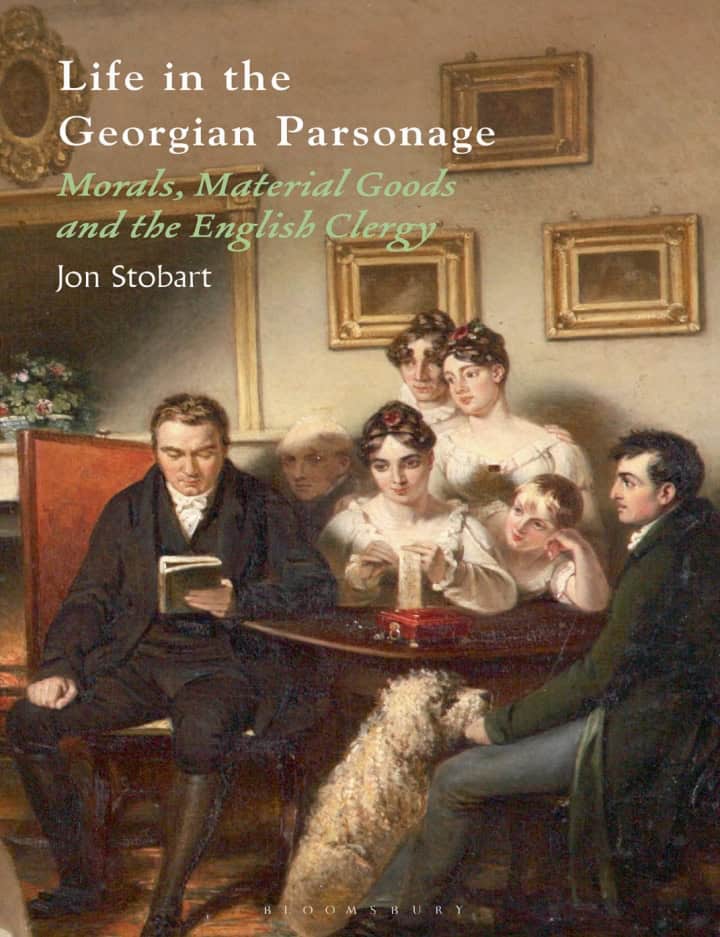
Life in the Georgian Parsonage: Morals, Material Goods and the English Clergy, by Professor Jon Stobart
How should a cleric of the Church of England live, particularly in terms of their material comforts, if they are to fulfil their canonical obligation to make themselves “wholesome examples and patterns to the flock of Christ”? Most of us would have no difficulty in recognising the standard of living of the clergy we know as meeting that requirement.
But was it ever thus, particularly in the long eighteenth century, when clergy were regularly satirised for living high on the hog, on incomes derived from pluralism and the grasping collection of tithes, whilst neglecting their religious and charitable duties?
We might easily assume that those criticisms were fully justified, given the traditional perception of the Church of England languishing in the doldrums before the ‘Victorian revival’. But recent historical writing has led to a significant re-evaluation of that judgement; and this book, a serious academic study by the cultural historian Professor Jon Stobart, seeks similarly to look afresh at the evidence of the way clergy actually lived during that period. In doing so it draws on a wide and colourful range of sources — including archives, parish records, letters, diaries, and household accounts.
Professor Stobart begins by examining the moral and theological context in which clergy lived and worked. On the positive side, the recognition of the demands of Christian ministry meant that there was no shortage of teaching, in published sermons and elsewhere, about the need to practise moderation and avoid worldliness. But, conversely, clergy were also swayed by the perceived need for them to live with ‘dignity’ if they were to be respected and taken seriously in their ministry. And wider societal perspectives — such as the view that ‘politeness’ and Christianity went hand in hand and that luxuries were good for the economy — could also encourage more conspicuous consumption.
One of the areas in which these issues arose most starkly was that of the parsonage house, as both the embodiment of these tensions and the place in which they were played out. Encouraged by the increasing number of sons of the gentry entering the ministry and expecting a lifestyle commensurate with their origins, over the course of the period parsonages ceased to look like farmhouses and became more like the houses of the gentry, with drawing and dining rooms and studies, together with greater provision for servants.
The position in relation to the furnishing of their parsonages, and the practice of politeness and hospitality within them, was similar, with clergy and their families constructing a social life over the period of a kind that was not unlike that of their more affluent neighbours (even if clergy nearly always had far more books than their neighbours and spent more time reading them). The result was, the author believes, that clergy were innovative consumers, having a greater capacity and propensity than many other groups to own goods linked to sociability and comfort — even if they formed a distinct social group, rather than being a clearly defined rung on the social ladder.
Against this background, clergy needed, the author suggests, “to find a compromise between worldliness, the dignity of their social position and their spirituality”. Whilst not all did so (and the book contains some colourful examples of such failure, not least as a result of ambition) his conclusion overall is that most clergy behaved in ways that were consistent with their social, community and religious status — performing their duties conscientiously (not least in the care they devoted to preaching), putting limits on their comforts and giving generously to charitable causes. That may have been the result of an intuitive understanding of ‘moderation’ that diluted their desire for ‘dignity’. But it was nonetheless broadly effective, allowing them to achieve a difficult balancing act in maintaining both their position in an increasingly prosperous society and a proper focus on their Christian duties.
This is a lively work, full of colour and detailed anecdotal evidence that brings its subjects to life vividly, and constructs a rounded portrait of the parson not only as a religious figure but also as a member of a particular social class embedded within a network of economic, cultural, and familial obligations.
If the book has a weakness beyond (for the general reader) its density, it perhaps lies in its failure to follow up on ways in which different theological positions may have influenced behaviour: we are told at one point that “attitudes within the Church of a England were never homogeneous – High and Low churchmen taking very different views of excess”. But that distinction (a potentially significant one given the importance of just what represented ‘excess’) is not developed, or drawn out in the author’s assessment of the evidence.
However, that limitation does little to diminish the overall richness of the study. In consequence, Life in the Georgian Parsonage succeeds in offering a detailed, balanced, and humane account of the English clergy during a transformative period in British history. By restoring complexity to figures often flattened by caricature, the book contributes to our understanding of the clergy of the Church of England in the long eighteenth century and the factors that influenced how they and their families related to the social and material culture around them. It also reminds us that clergy households were, and are, communities shaped not only by personality, aspiration, and the surrounding culture but also by principle.
Life in the Georgian Parsonage: Morals, Material Goods and the English Clergy, Jon Stobart, Bloomsbury Visual Arts, 2025, 392 pages, 102 colour illustrations, ISBN 9781350382107., Paperback £24.41