
On Wednesday 18 March, the new Archbishop of Canterbury set out on foot from London on a 6-day pilgrimage to Canterbury Cathedral for her installation there on the 25th. Her journey is a reminder of the days of Chaucer when pilgrims regularly journeyed to the famous shrine of St Thomas Becket at the site of his martyrdom in the Cathedral in 1170. What echoes of Becket, and the wider custom of pilgrimage, can we find among our Oxfordshire churches?
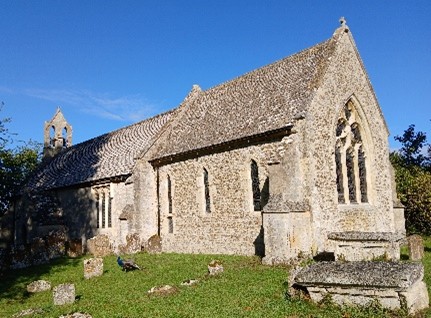


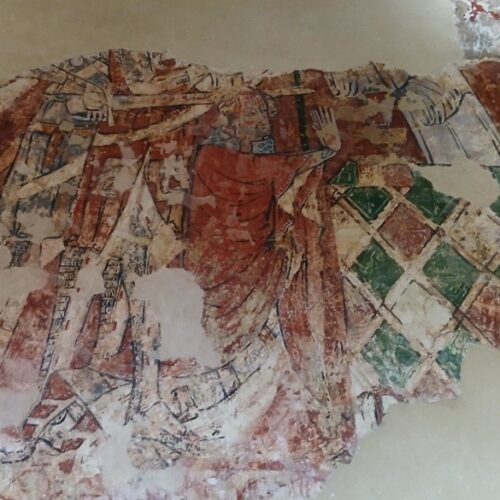
At least two churches are dedicated to him, St Thomas of Canterbury at Elsfield, and in Oxford itself, the church of St Thomas the Martyr in Becket Street. Both of these churches were medieval foundations, with dedications testifying to the popular devotion to the saint. Even more striking, though, are the astonishing wall-paintings, showing the scene of Becket’s martyrdom, at South Newington.
The earliest parts of St Peter ad Vincula, South Newington, date from the early 1300s, although like many of our churches it was further extended in the later fourteenth and fifteenth centuries.
Its particular glory is found in its wall-paintings, most notably on the north wall a scene depicting the murder of Becket by the four knights. In it, Becket kneels looking towards the altar, hands held up either in prayer or to restrain intervention by his chaplain, whose white sleeves can be seen on the right. Swords are held menacingly above his head, evidently about to fall. It is astonishingly clear and vivid in its detail, and would surely have kept the story of Becket alive among all who saw it.
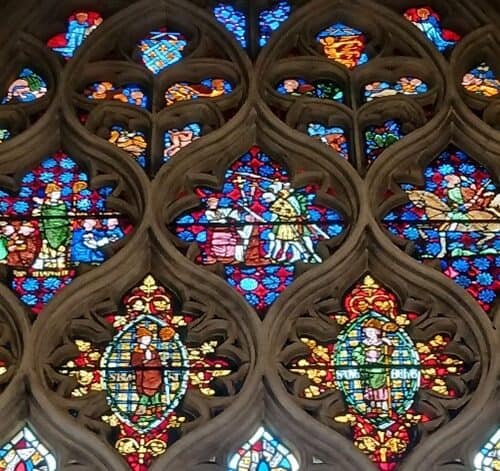
The South Newington wall paintings date from around 1330, and Oxford has another striking reminder of Becket in a stained glass window of only a decade or so later.
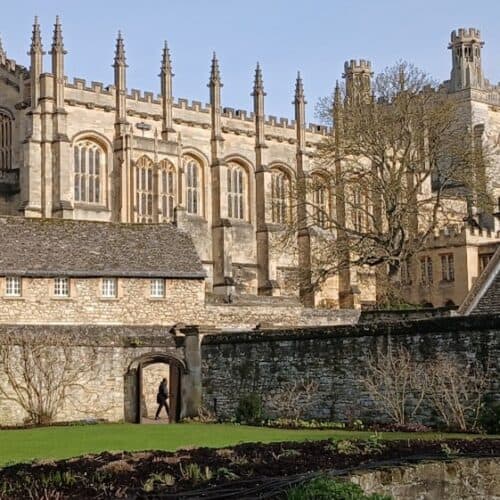
This is what is now known as the ‘Becket Window’ in the east window of St Lucy’s Chapel in Oxford Cathedral. The central lozenge in the second row of the richly coloured glass shows the martyrdom of the Archbishop.

While Becket’s shrine at Canterbury was perhaps the premier destination in England for pilgrims, there were lesser-known shrines which were also centres for devotional journeys. You can find other reminders of some of them in other Oxfordshire churches. The remains of a shrine devoted to the Saxon princess St Edburg, once in Bicester Priory, can now be found in the church of St Michael and All Angels, Stanton Harcourt. At the Reformation it was removed (or rescued) from Bicester by Sir Robert Harcourt, then Sheriff of Oxfordshire, and brought to St Michael’s where it now stands against the north wall of the chancel.
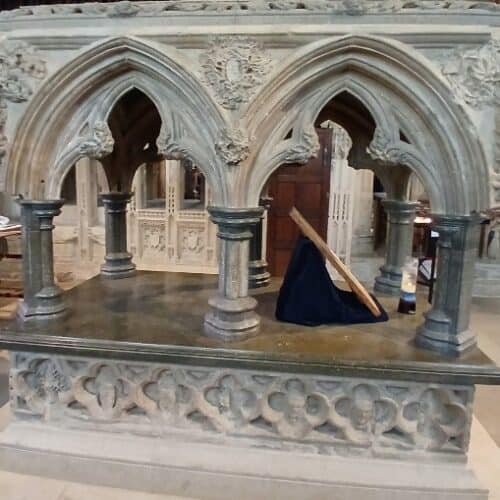
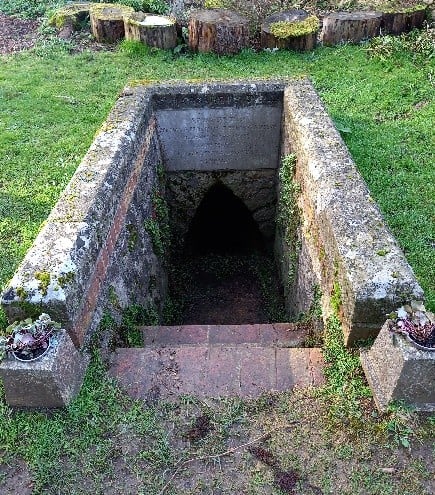
Oxford’s own patron saint is another Saxon princess, Frideswide, and the remains of her shrine are still to be found in the Cathedral. Go and look at it, and perhaps afterwards walk west along the Thames Path to find St Margaret of Antioch, Binsey, and the site in the churchyard there of what was once regarded as St Frideswide’s healing well.
Or simply plan your own pilgrimage, by choosing a route that takes you to some of our other wonderful range of Oxfordshire churches.
Elizabeth Knowles
All photographs © Elizabeth Knowles.