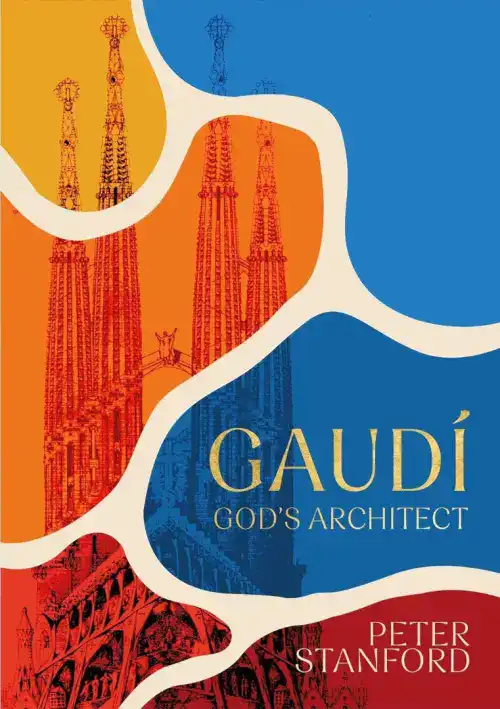
Gaudi: God’s Architect, Peter Stanford
This lengthy biography is published almost exactly a hundred years after the tragic death of Antoni Gaudi after falling under a tram in 1926. It coincides with the installation of the final piece of the central tower of the Basilica of Sagrada Familia that made it the tallest church in the world. The building itself, although it still remains unfinished, is an extraordinary monument to one of the most original architects of the late-nineteenth and early-twentieth centuries. After his final examination at the Barcelona school of architecture the Director is said to have remarked Today we have turned out an architect who will either be a madman or a genius. Given his subsequent commissions which attract so many tourists to the city, it is undoubtedly the latter although there are still some critics who favour the former.
Whatever your opinion, Sagrada is his masterpiece. He was first engaged as its chief architect in 1883, a year after the construction of a conventional Gothic church had begun. It was Gaudi who shaped the fascinating building that has emerged. It has had a chequered history as it has become increasingly more expensive to achieve his singular vision. In 1926 it was less than a quarter complete. Work continued after his death but in 1936 it was partially destroyed during the Spanish Civil War. Construction resumed after 1939 and continues today.
Over the course of eleven chapters set out in chronological order and covering all his commissions, Stanford’s biography analyses in minute detail the symbolism of the forms and decoration which are such a striking component of all Gaudi’s buildings although he makes it clear that many of his conclusion are speculative. The importance of his birth and upbringing in the rural countryside of Catalonia and his deep Catholic faith are stressed throughout. His unusual methods of design and the composition of his workshop are explored against the background of his difficult personality and his lonely private life. The political and social conflicts that affected Spain in general and Barcelona in particular during this period provide an appropriate context for his patronage by wealthy industrialists and his deep loyalty to his Catalonian heritage. However, it must be said that the book makes a heavy demand on the reader. There are too many repetitions and personal biographical interventions by the author which should have been picked up at the editorial stage. In seeking to reflect its subject, the mannered design is not altogether successful. The print is small and the footnotes are minute. The page numbers are placed halfway up the margins and the illustrations are framed in the eccentric shape of windows in Gaudi’s buildings and are reproduced at such a small size that it is difficult to see the details that are highlighted in the text. Given its length and weight, this is a book to read at home rather than to take on a pilgrimage to Barcelona.
Gaudi: God’s Architect, Peter Stanford, (Hodder & Stoughton, 2026), 406 pages, many colour illustrations, ISBN 9781399811811, hardback, £30.